Dunleary Lifeboat Project

The Service History of RNLB Dunleary (ON 658)

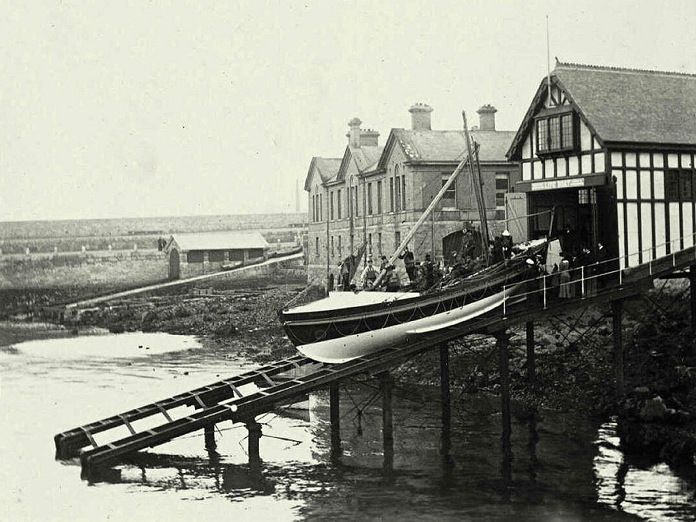
The RNLB Dunleary was a 45ft Watson-class motor lifeboat, built in 1919 by S.E. Saunders at Cowes. She was funded by the Civil Service, Post Office and British Telecom Lifeboat Fund, at a cost of £8,000. To accommodate her, the boathouse and slipway at Kingstown (now Dún Laoghaire) were altered at an additional cost of £1,550, also met by the Fund.

She was launched in December 1919 and formally named by the Countess of Fingall. Powered by a single 60hp Tylor petrol engine, she represented the modern motor lifeboat design of her day, and her arrival marked a new chapter in the lifesaving story of Kingstown.

Service in Kingstown, 1919–1938

For nearly two decades, the Dunleary served the waters of Dublin Bay and beyond. During her stationing at Kingstown, she launched 23 times and was credited with saving 55 lives.

Among her notable services:

  • 7 February 1923 – The lifeboat launched at 8.15 a.m. to the fishing boat Katie, bringing her crew of three safely ashore.

  • 29 October 1925 – The 2,000-ton vessel Hamburg stranded near the Coastguard Station. Launched at 3.45 p.m., the Dunleary rescued all 46 people aboard.

  • 2 June 1936 – In rough seas and a north-easterly gale, she towed the disabled yacht Vixen to safety, saving her owner.

By 1938, a new lifeboat had been allocated to Kingstown, and the Dunleary was reassigned to Lytham, Lancashire.

Service in Lytham St Annes, 1939–1951

Arriving at her new station in 1939, the Dunleary quickly proved her worth in wartime conditions. Between 1939 and 1951, she launched 58 times and saved 30 lives.

Two services in particular stand out:

  • 25 November 1939 – In the early hours, the Dunleary rescued the crew of 15 from H.M. Trawler Gaul, landing them safely at 2.45 a.m. Later that same morning, she was launched again to the pilot boat Charles Livingstone, which had run ashore at Ainsdale Beach. Despite dangerous conditions, Coxswain John Parkinson skilfully manoeuvred alongside. Although the two remaining crew refused to leave, Parkinson’s bravery earned him the RNLI Silver Medal, while Motor Mechanic G. Harrison received the Bronze Medal.

  • 9 July 1944 – The fishing vessel Gipsy, with a crew of five, was reported in distress near the Wall End Buoy. The Dunleary slipped her moorings at 2.20 p.m. into a SSE gale. Two lifeboatmen were placed aboard and the vessel was towed safely to Lytham.


Legacy

In her combined service at Kingstown and Lytham, the Dunleary launched 81 times and saved 85 lives. She embodied the commitment, courage, and endurance of the RNLI crews who served aboard her, both in peacetime and through the challenges of the Second World War.

Today, through the efforts of the Dunleary Lifeboat Project, this remarkable vessel is being preserved so that her story — and the lives she touched — will not be forgotten.